
Poirot and Oliver’s Trusted Partnership
Hallowe'en PartyThis thread traces how a long-standing friendship turns Ariadne Oliver’s distress into the trust and investigative cooperation that helps Poirot uncover the truth.
increasing Bearing strength in each event
 decreasing
Bearing strength in each eventdecreasingAn Urgent Call

A Friend in Distress
The Call
Ariadne Oliver telephones Hercule Poirot in an agitated state, asking to see him immediately. She believes he is the one person who might tell her what to do, a confidence that signals the depth of their friendship before she has even explained the crisis.
Poirot recognizes her breathlessness and emotion, but also anticipates the winding, unpredictable account that may follow. His mild impatience does not prevent him from welcoming her; familiarity lets him understand that her urgency deserves attention.
A Confidence Entrusted
When Oliver arrives in dripping oilskins, Poirot first attends to her comfort and offers a drink. Her shock is so great that even her usual conversational digressions give way to difficulty finding a beginning.
The friendship gives Oliver a place to speak without needing to present a polished theory. Poirot listens until the account of the party becomes an account of a murdered child, and her personal alarm becomes the starting point of his investigation.
The Witness’s Confidence
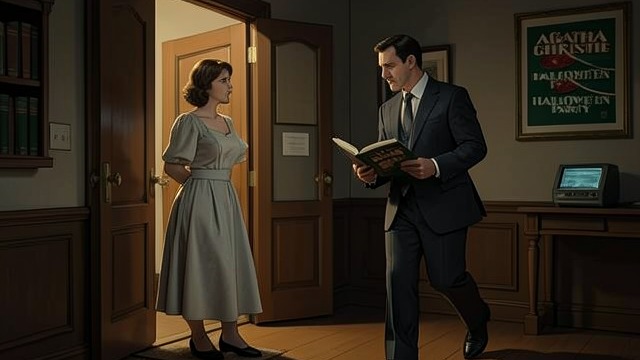
A Shared Investigation
Respectful Persistence
At Apple Trees, Poirot meets Oliver at the house where Joyce Reynolds was killed. Oliver is unable to enter the library, while Poirot studies the scene and proceeds with the interviews she helped make possible.
Their companionship does not depend on identical temperaments. Oliver reacts emotionally and speaks candidly; Poirot works methodically, asking questions that can seem detached even when the subject is painful. Each accepts the other’s way of approaching the tragedy.
A Continuing Conversation
Oliver asks what Poirot is doing and compares his orderly plan to a computer processing information. Her teasing gives their serious work a familiar ease, while his willingness to entertain her comparison shows that he values her perceptions rather than treating her as a mere source of evidence.
As the inquiries widen to Joyce’s character and the people around the party, Oliver remains his companion and sounding board. Her presence keeps the investigation connected to the ordinary human shock that first brought it to him.
Ariadne’s New Clue

Trust Through Conversation
The Puzzle of the Past
Poirot explains to Oliver that he is working backward from Joyce’s death through earlier deaths, a missing au pair, and a disputed codicil. Oliver is initially frustrated by the backward direction of his thinking, but she continues to question him and helps expose what remains uncertain.
Their exchange becomes a shared exercise in interpretation. Oliver offers a possible account of how a genuine codicil could have been replaced by a forged one, while Poirot tests her explanation against the facts he has gathered.
News Worth Acting On
Oliver then reports what Harriet Leaman told her: that she and James Jenkins witnessed Mrs Llewellyn-Smythe sign a document. The new information complicates Poirot’s understanding of the forged document, but he does not dismiss Oliver’s discovery simply because it disrupts his working theory.
He uses Oliver’s telephone to check the crucial detail with the solicitor. Their relationship has become practical collaboration: she brings an unexpected lead, and he knows to verify it rather than either accept or reject it on instinct.
The Protective Request

Friendship Under Threat
A Precaution Entrusted
After Leopold Reynolds is killed, Poirot recognizes that another person may be in immediate danger. He asks Oliver whether she can accommodate guests in London, drawing on the practical confidence that has grown between them over years of friendship and the current investigation.
Oliver does not yet know exactly whom Poirot wants to protect, but she understands that he is asking for more than a casual favor. She agrees that she can receive guests, allowing him to arrange a safeguard before explaining the danger in full.
Obedience and Concern
Poirot later sends a telegram instructing Oliver to bring Judith Butler and Miranda Butler to London at once. Oliver obeys, using a harmless story about a medical appointment as cover and insisting that Miranda travel with them.
Her quick action shows both loyalty to Poirot and genuine concern for Judith and her daughter. When Miranda disappears during their stop at The Black Boy, Oliver immediately calls Poirot; their trust now carries the weight of a child’s safety.
The Friendship Reaffirmed

Gratitude Without Blame
The Story’s Cost
Once the murders and the attempted killing of Miranda are explained, Oliver presses Poirot to tell her how he reached the solution. She still jokes that he will blame her for bringing the case to his attention, but beneath the complaint is the recognition that her presence began the chain of events that brought him to Woodleigh Common.
Poirot answers by crediting her with bringing the tragedy to him. Their familiar banter survives the grim revelations, showing that the investigation has not reduced their friendship to a professional arrangement.
A Warm Departure
Poirot thanks Oliver for drawing his attention to the case and bids her good night. Oliver’s exasperated reply—again resisting the suggestion that the responsibility is hers—returns them to their characteristic teasing rhythm.
The farewell closes the immediate partnership without diminishing it. Oliver’s distress had given Poirot the reason to act, and his patient attention had given her a trusted ally in a crisis that she could not resolve alone.
The evening after the Hallowe'en party
The next day, when Poirot reaches Apple Trees
Several days after the party, at Judith Butler’s house
After the second drowning, as Poirot prepares to leave Woodleigh Common
After the crimes are exposed, during Poirot’s farewell
